




Vermicompost
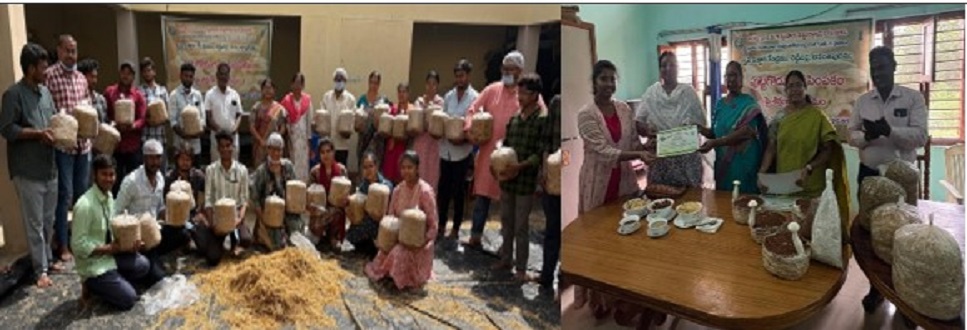
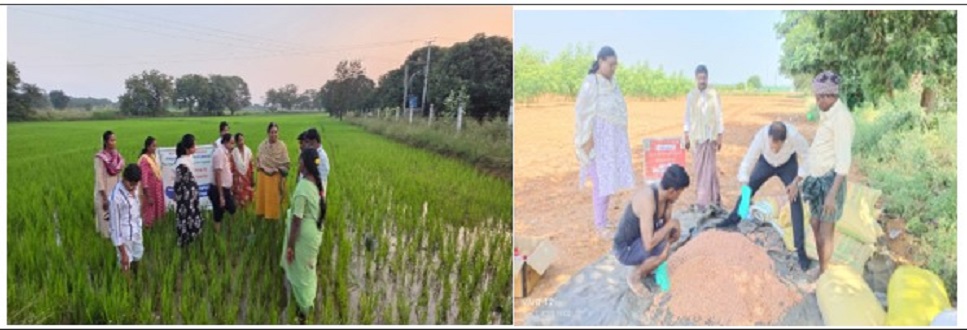
Vermicomposting is the scientific method of making compost, by using earthworms. They are commonly found living in soil, feeding on biomass and excreting it in a digested form. Earthworms feed on the organic waste materials and give out excreta in the form of “vermicasts” that are rich in nitrates and minerals such as phosphorus, magnesium, calcium and potassium. These are used as fertilizers and enhance soil quality. Vermicomposting at KVK, Reddipalli is prepared by pit Method. In this method, the organic matter is collected in cemented pits.
Process of Vermicomposting
- To prepare vermicompost pits, 30 ´ 4.5 ft. pits were prepared with Kadapa slabs.
- Collect the biomass and place it under the sun for about 8-12 days. Now chop it to the required size using the cutter.
- Prepare a cow dung slurry and sprinkle it on the heap for quick decomposition.
- Add a layer (2 – 3 inch) of soil or sand at the bottom of the tank.
- Now prepare fine bedding by adding partially decomposed cow dung, dried leaves and other biodegradable wastes collected from fields and kitchen. Distribute them evenly on the sand layer.
- Continue adding both the chopped bio-waste and partially decomposed cow dung layer-wise into the tank up to a depth of 0.5-1.0 ft.
- After adding all the bio-wastes, release the earthworm species (10 – 20 /pit) over the mixture and cover the compost mixture with dry straw or gunny bags.
- Sprinkle water on a regular basis to maintain the moisture content of the compost.
- Cover the tank with a thatch roof to prevent the entry of ants, lizards, mouse, snakes, etc. and protect the compost from rainwater and direct sunshine.
- Have a frequent check to avoid the compost from overheating. Maintain proper moisture and temperature.
After the 24th day, around 4000 to 5000 new worms are introduced and the entire raw material is turned into the vermicompost. After 3-4 months it is ready to harvest.
The nutrients profile of vermicompost:
1.6 per cent of Nitrogen.
0.7 per cent of Phosphorus.
0.8 per cent of Potassium.
0.5 per cent of Calcium.
0.2 per cent of Magnesium.
175 ppm of Iron.
96.5 ppm of Manganese.
24.5 ppm of Zinc.
Advantages of Vermicomposting
The major benefits of vermicomposting are:
- Develops roots of the plants.
- Improves the physical structure of the soil.
- Vermicomposting increases the fertility and water-resistance of the soil.
- Helps in germination, plant growth, and crop yield.
- Nurtures soil with plant growth hormones such as auxins, gibberellic acid, etc.
Vermicomposting is an eco-friendly process that recycles organic waste into compost and produces valuable nutrients.
Economics of construction Vermicompost shed (5 pits)
|
S.No |
Particulars |
Quantity |
|
1. |
Kadapa slabs |
1400 Sq.ft |
|
2. |
2.5’’ iron rods (20 feet) |
4 No. |
|
3. |
2.0’’ iron rods (20 feet) |
4 No. |
|
4. |
Asbestos sheets (6.0 × 3.5 feet) |
30 no. |
|
5. |
J-bolts |
60 sets |
|
6. |
Sand (Tractor load) |
1 load |
|
|
